MAPEGY 2024's MOBILITY Disruptors: Top 10 Companies to Watch
Nina Zimmermann
·
March 18, 2026

2026 Edge AI Technology Report: Trends, Signals & Strategic Insights

Signals, Technologies and Market Forces Behind the Next Wave of Distributed Intelligence

The 2026 Edge AI Technology Report, developed by MAPEGY together with Wevolver, analyzes the technological, economic and regulatory signals shaping this transition.

Using innovation intelligence data from MAPEGY SCOUT, the report maps:

  • emerging Edge AI technologies
  • research activity and patents
  • companies and funding signals
  • regulatory drivers
  • infrastructure shifts from cloud to edge

The analysis highlights a fundamental transition in AI architecture:
training remains concentrated in the cloud, while inference increasingly moves to edge devices and distributed systems. Explore the full report

Several indicators illustrate the scale of this shift:

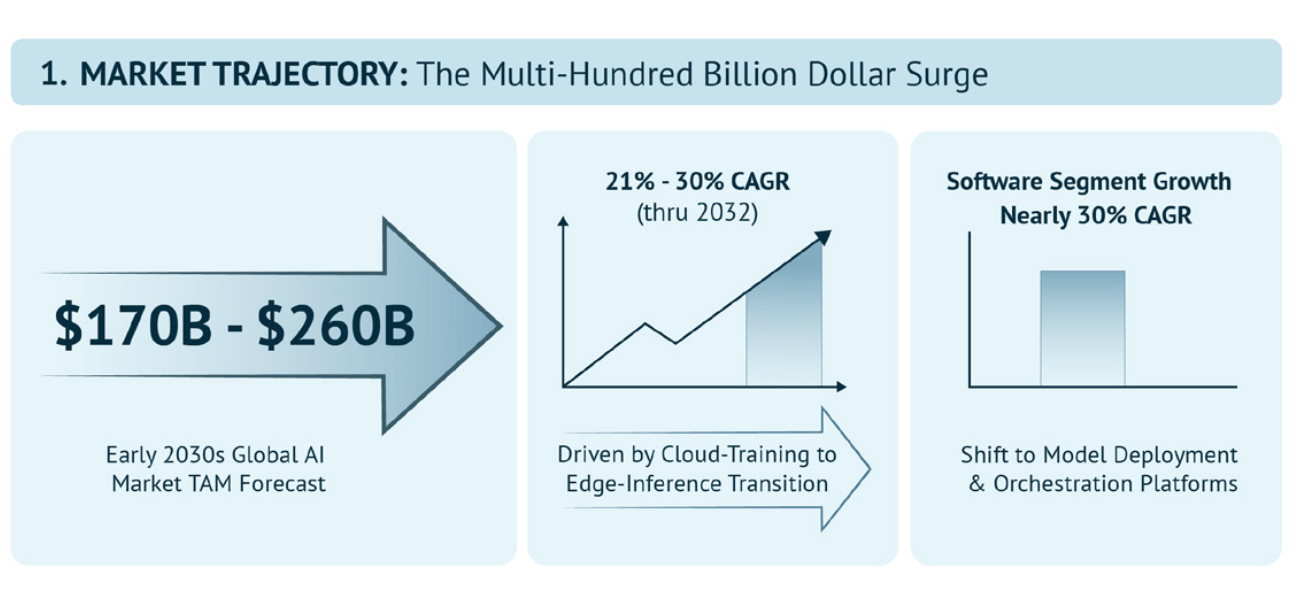
  • Global Edge AI markets projected at $170B–$260B TAM by the early 2030s
  • Market growth estimated at 21–30% CAGR through 2032
  • Nearly 30% CAGR growth in the software segment driven by deployment and orchestration platforms

Market Trajectory: The Multi-Hundred Billion Dollar Surge

This market expansion is driven by the shift from centralized AI architectures toward distributed inference systems operating directly on devices, machines and infrastructure. Explore the full report

Key drivers include:

  1. Migration from cloud-centric AI to edge inference architectures
  2. Rapid expansion of connected devices and embedded intelligence
  3. Deployment of AI in robotics, industrial automation and mobility
  4. Growing demand for real-time decision making with low latency
  5. Increasing regulatory pressure around privacy and secure AI systems

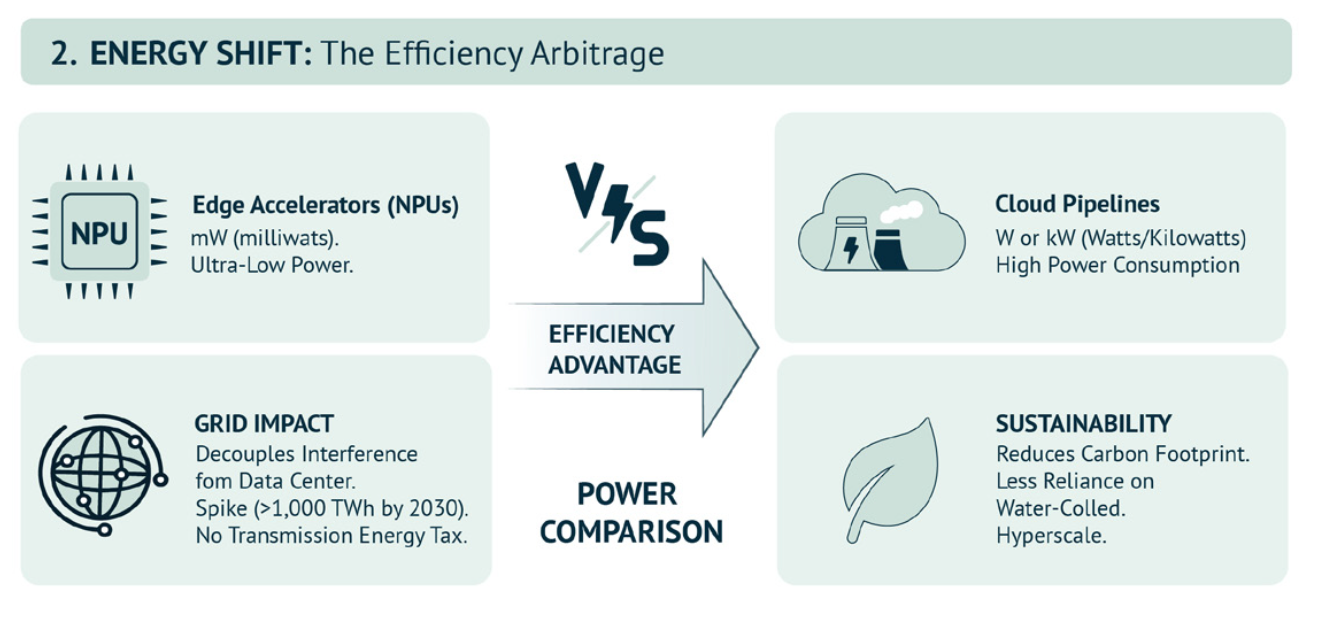
Energy Shift: The Efficiency Arbitrage

One of the strongest structural drivers behind Edge AI is the energy efficiency gap between cloud training and edge inference.

Edge AI accelerators such as NPUs operate in milliwatts, while large cloud inference pipelines require watts or kilowatts of power. This creates a major efficiency advantage for on-device intelligence.

Key implications highlighted in the report:

  1. Edge accelerators dramatically reduce energy consumption per inference task
  2. Edge inference reduces data center load and transmission energy costs
  3. Distributed architectures decrease reliance on hyperscale infrastructure
  4. Lower energy consumption improves sustainability metrics
  5. AI workloads increasingly split between cloud training and edge inference

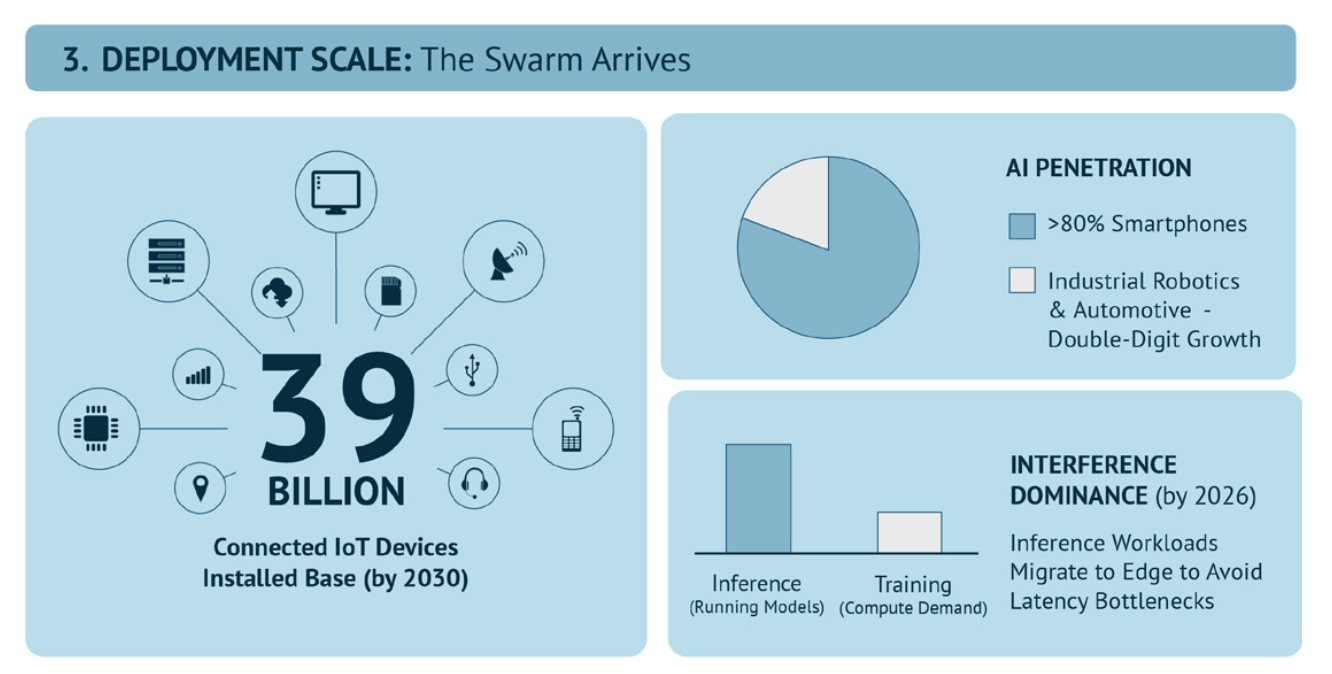
Deployment Scale: The Swarm Arrives

The rapid growth of connected devices is transforming the scale of AI deployment. By 2030, the global installed base of connected devices is expected to reach 39 billion IoT devices. This creates a massive infrastructure layer capable of hosting distributed intelligence. Explore the full report

Key deployment signals identified in the report:

  1. AI already present in more than 80% of smartphones
  2. Industrial robotics and automotive sectors show double-digit AI adoption growth
  3. Inference workloads increasingly migrate to the edge to reduce latency
  4. Device-level AI enables real-time decision making without cloud connectivity
  5. Large networks of intelligent devices form distributed AI swarms

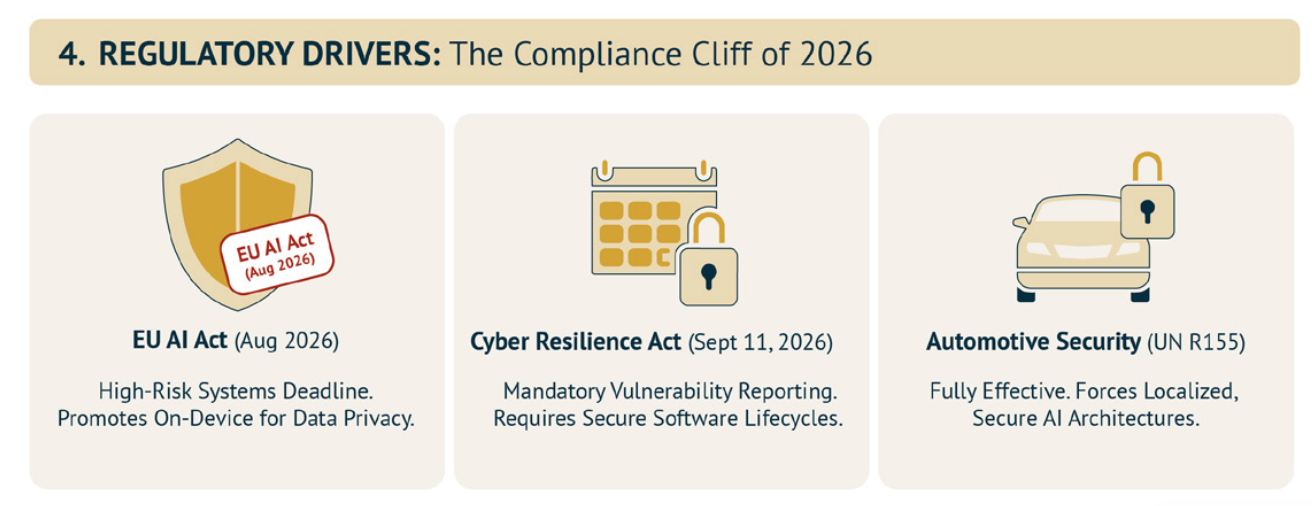
Regulatory Drivers: The Compliance Cliff of 2026

Regulatory developments are becoming a major driver of Edge AI adoption. Several new regulations require stronger control over data processing, model deployment and software security. Explore the full report

Key regulatory milestones include:

  1. EU AI Act (August 2026) introducing strict compliance requirements for high-risk AI systems
  2. Cyber Resilience Act (September 2026) requiring secure software lifecycle management and vulnerability reporting
  3. Automotive security regulation (UN R155) enforcing secure AI architectures in vehicles
  4. Growing regulatory pressure for localized data processing
  5. Increased demand for secure and explainable AI architectures

These regulations encourage organizations to deploy AI closer to where data is generated.

Technology Landscape: The Core Edge AI Stack The report explores the technological foundations enabling Edge AI across ten chapters.

Below is a brief overview of the core themes. Explore the full report

Chapter 1 – Edge Foundation Models

Key topics covered:

  1. Emergence of Small Language Models (SLMs) optimized for edge environments
  2. Model compression techniques including distillation and quantization
  3. Increasing importance of hardware acceleration through NPUs
  4. Evolution toward hybrid architectures combining cloud and edge AI
  5. Expansion of efficient AI models into embedded devices

Chapter 2 – Multimodal Edge Models. This chapter explores how machines combine multiple input modalities.

Key topics:

  1. Fusion architectures combining vision, audio and sensor data
  2. Vision-language models optimized for edge deployment
  3. Event-based vision systems inspired by biological perception
  4. Multimodal AI in industrial reliability and predictive maintenance
  5. Multimodal perception in robotics and autonomous systems

Chapter 3 – Ultra-Low-Power Architectures

Edge AI requires radically different computing architectures.

Key topics:

  1. Neuromorphic computing and spiking neural networks
  2. TinyML and ultra-efficient machine learning architectures
  3. In-sensor processing and event-based vision
  4. Energy-efficient edge hardware architectures
  5. Sustainability considerations for AI infrastructure

Chapter 4 – Agentic AI at the Edge. The report analyzes the rise of autonomous AI systems operating locally.

Key themes:

  1. Architecture of autonomous edge agents
  2. Hardware infrastructure enabling agentic AI systems
  3. Development frameworks for edge AI agents
  4. Digital twin simulation for training and testing
  5. Safety and liability considerations for autonomous AI

Chapter 5 – Physical and Embodied AI. This chapter focuses on AI systems interacting with the physical world.

Key topics:

  1. Vision and spatial perception in robotic systems
  2. Learning-based control systems replacing traditional PID controllers
  3. Compute infrastructure for embodied intelligence
  4. Simulation environments and lifelong learning approaches
  5. Safety frameworks for autonomous physical systems

Chapter 6 – Edge MLOps and Orchestration. As Edge AI scales, managing distributed models becomes critical.

Key topics:

  1. AI-driven orchestration systems for telecom networks
  2. Containerized endpoints for edge deployments
  3. Model telemetry and drift detection
  4. Over-the-air model deployment and CI/CD pipelines
  5. Governance and trust management for distributed AI

Chapter 7 – Connectivity and Collaborative Learning. Edge systems increasingly operate in collaborative networks.

Key topics:

  1. Multi-access edge computing (MEC) architectures
  2. Federated learning across distributed devices
  3. Swarm learning and reinforcement learning maps
  4. AI-native modem chips enabling device collaboration
  5. Privacy-preserving distributed learning frameworks

Chapter 8 – Hyper-Personalization and Contextual AI. This chapter explores AI systems that adapt to user context.

Key topics:

  1. Context-aware intelligence engines
  2. On-device retrieval-augmented generation
  3. Local vector databases for personalized models
  4. On-device continual learning
  5. Ethical safeguards against manipulation

Chapter 9 – Trust Stack for Edge AI. As AI systems distribute across infrastructure, trust becomes critical.

Key topics:

  1. Secure hardware architectures
  2. Confidential computing and privacy protection
  3. Explainability and transparency mechanisms
  4. Energy accountability and sustainability
  5. Development of unified trust architectures

Chapter 10 – Future of Edge AI. The final chapter examines the trajectory of Edge AI technologies.

Key insights:

  1. Emerging technology frontiers identified through innovation signals
  2. Industry standards and regulatory frameworks shaping deployment
  3. Rapid expansion of AI-enabled industrial infrastructure
  4. Growth of distributed intelligence architectures
  5. Long-term transformation of computing infrastructure

Explore the Edge AI Technology Landscape

The report includes:

  • 10 analytical chapters
  • detailed analysis of 9 emerging Edge AI technologies
  • technology radars and KPI dashboards
  • patent, research, funding and company indicators
  • expert-defined SCOUT queries used to map each domain

Together these analyses provide a structured view of the technological signals shaping the next generation of Edge AI systems.

Explore the full report

Drive Innovation Smarter and Faster
in the Digital Era.

Transform your enterprise with cutting-edge AI insights. Enhance decision-making, uncover market trends, and drive growth with real-time, automated intelligence.

100x Faster Insights

70% Cost Cut

Uncover Game-changing Patterns